
(TAP) - The Spokesperson of Vietnam’s Ministry of Foreign Affairs called on the United States to make an objective assessment of Vietnam’s achievements in protecting intellectual property rights. The statement came after the U.S. designated Vietnam as a “Priority Foreign Country” - the highest level in its evaluation of intellectual property rights violations.
At a regular press briefing on May 1, the Spokesperson of Vietnam’s Ministry of Foreign Affairs, Pham Thu Hang, responded to a reporter’s question requesting Vietnam’s reaction to the United States placing Vietnam on the “Priority Foreign Country” list in its annual report on the global situation of intellectual property protection and enforcement. According to Pham Thu Hang, in recent years, Vietnam has consistently made strong efforts to protect intellectual property, including improving its legal framework, raising public awareness, and strengthening international cooperation with the World Intellectual Property Organization (WIPO), the United States, and many other countries; while also resolutely combating and strictly handling intellectual property violations. She affirmed that this is both a top priority and a consistent policy for Vietnam in building a healthy and transparent business environment, and in transforming its growth model with science and technology, innovation, and digital transformation as the main driving forces.
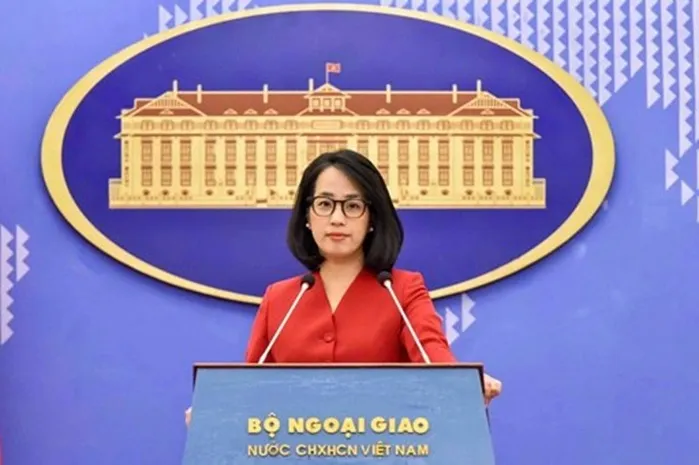
Spokesperson of Vietnam’s Ministry of Foreign Affairs, Pham Thu Hang, responds to the United States placing Vietnam in the “Priority Foreign Country” category in relation to intellectual property rights. Source: mofa.gov.vn
The Spokesperson of Vietnam’s Ministry of Foreign Affairs stated clearly: “We request that the United States make an objective and balanced assessment of Vietnam’s efforts and achievements in the field of intellectual property protection”. Pham Thu Hang emphasized that Vietnam is cooperating very actively and effectively with the United States, and is ready to share information and clarify its policies and regulations. She noted that both sides need to continue close coordination to properly address differences, for the benefit of both countries, and toward building a stable, balanced, and sustainable framework for economic and trade cooperation.
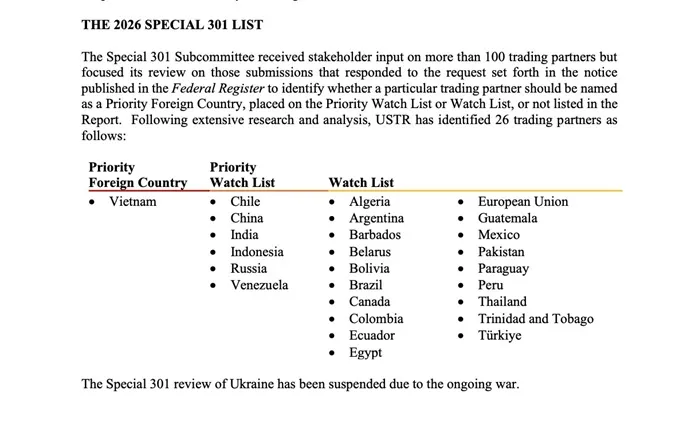
The U.S. Trade Representative (USTR) has placed Vietnam in the “Priority Foreign Country” category in the 2026 Special 301 Report on the protection and enforcement of intellectual property (IP) rights. Source: ustr.gov
Earlier, on April 30, the Office of the United States Trade Representative (USTR) released the 2026 Special 301 Report on the protection and enforcement of intellectual property (IP) rights among U.S. trading partners. Notably, the USTR placed Vietnam in the “Priority Foreign Country” (PFC) category - reserved for countries with “the most serious acts, policies, and practices related to intellectual property that have the greatest adverse impact on relevant U.S. products”. According to the USTR, this is the first time in 13 years that a country has been listed in this most severe category. However, the United States emphasized that the PFC designation for Vietnam is based solely on concerns related to intellectual property rights and does not reflect other aspects of its domestic or foreign policy.
Explaining the decision, the U.S. Trade Representative (USTR) stated that the 2026 review found that Vietnam has not made substantial improvements in addressing long-standing concerns related to the protection and enforcement of intellectual property rights, including: (1) failure to ensure consistent and effective enforcement against online copyright infringement; (2) ineffective control over the large-scale production and trade of counterfeit and pirated goods; (3) limitations in border enforcement mechanisms for intellectual property rights; (4) lack of sufficiently strong measures to address the use of unlicensed software; and (5) ineffective application of criminal penalties against cable and satellite signal piracy.
The USTR added that since 2020, the United States has proposed the development of an Intellectual Property (IP) Work Plan to address the issues raised in the Special 301 Report, and further revised the proposal in 2023. However, the USTR assessed that bilateral exchanges as well as recent negotiations on the Agreement on Reciprocal, Fair, and Balanced Trade have not yielded significant progress. These persistent shortcomings in action and enforcement have had negative impacts on industries that rely on intellectual property, not only in the Vietnamese market but also extending to other markets.
As Vietnam has been officially placed in the PFC category, the USTR will, within 30 days, consider initiating an investigation under Section 301 of the U.S. Trade Act of 1974. If it decides to launch the investigation, the USTR will request consultations with Vietnam and seek to resolve the issue.
Mie Duong